
Some things you need to know
If you're getting started with Bitcoin, there are a few things you should know. Bitcoin lets you exchange money and transact in a different way than you normally do. As such, you should take time to inform yourself before using Bitcoin for any serious transaction. Bitcoin should be treated with the same care as your regular wallet, or even more in some cases!
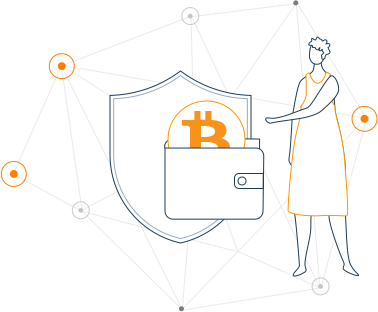
Securing your wallet
Like in real life, your wallet must be secured. Bitcoin makes it possible to transfer value anywhere in a very easy way and it allows you to be in control of your money. Such great features also come with great security concerns. At the same time, Bitcoin can provide very high levels of security if used correctly. Always remember that it is your responsibility to adopt good practices in order to protect your money. Read more about securing your wallet.
There is no undo button
Bitcoin has no central authority to reverse a mistake. If you permanently lose access to your wallet—for example by losing your recovery phrase—your funds are gone permanently. No one—not developers, miners, wallet providers, or exchanges—can recover funds that you permanently lose from a self-custodied wallet. Always back up your wallet and keep your recovery information safe and private.
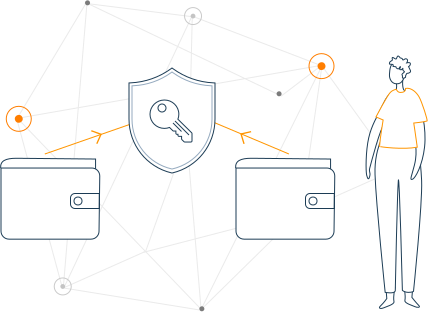
You are your own bank
When you hold your own private keys, you control your bitcoin—but you are also responsible for keeping it secure. If you leave your coins with an exchange or another custodian, you rely on that third party to safeguard them and to honor withdrawals. That reliance introduces counterparty risk: the custodian's own security, solvency, and policies now stand between you and your funds. Holding your own keys removes that risk, but requires you to secure your wallet and backups yourself.

Bitcoin is not anonymous
Some effort is required to protect your privacy with Bitcoin. All Bitcoin transactions are stored publicly and permanently on the network, which means anyone can see the balance and transactions of any Bitcoin address. However, the identity of the user behind an address remains unknown until information is revealed during a purchase or in other circumstances. This is one reason why Bitcoin addresses should only be used once. Always remember that it is your responsibility to adopt good practices in order to protect your privacy. Read more about protecting your privacy.
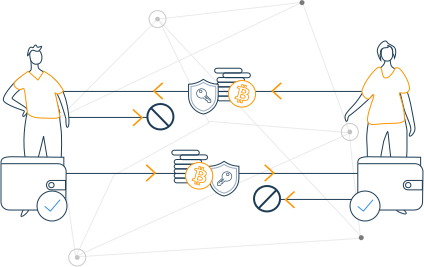
Bitcoin payments are irreversible
A Bitcoin transaction cannot be reversed, it can only be refunded by the person receiving the funds. This means you should take care to do business with people and organizations you know and trust, or who have an established reputation. For their part, businesses need to keep track of the payment requests they are displaying to their customers. Bitcoin can detect typos and usually won't let you send money to an invalid address by mistake, but it's best to have controls in place for additional safety and redundancy. Services such as escrow and multi-signature wallets provide additional choice and protection for both businesses and consumers.
| Confirmations | Lightweight wallets | Bitcoin Core |
|---|---|---|
| 0 | Only safe if you trust the person paying you | |
| 1 | Somewhat reliable | Mostly reliable |
| 3 | Mostly reliable | Highly reliable |
| 6 | Minimum recommendation for high-value bitcoin transfers | |
| 30 | Recommendation during emergencies to allow human intervention | |
Unconfirmed transactions aren't secure
Transactions do not become irreversible immediately. Instead, they accumulate confirmations, each making them increasingly difficult to reverse (see table). New blocks are added to the blockchain approximately every 10 minutes on average, but block discovery is probabilistic—an individual confirmation may arrive much sooner or much later, and there is no guaranteed minimum or maximum delay. If the transaction pays a fee below what the network is currently prioritizing, the first confirmation may take considerably longer.
Bitcoin price is volatile
The price of a bitcoin can unpredictably increase or decrease over a short period of time due to its economy, evolving adoption, and sometimes illiquid markets. Bitcoin should be treated as a high-risk asset, and you should never store money that you cannot afford to lose in bitcoin. If you receive payments with Bitcoin, many service providers can convert them to your local currency.
Bitcoin is still in active development
Bitcoin continues to evolve through active development. Improvements make the network more capable, but can also introduce new challenges as adoption grows. During these growing pains you might encounter increased fees, slower confirmations, or even more severe issues. Be prepared for problems and consult a technical expert before making any major investments, but keep in mind that nobody can predict Bitcoin's future.
Government taxes and regulations
Bitcoin is not an official currency. That said, most jurisdictions still require you to pay income, sales, payroll, and capital gains taxes on anything that has value, including bitcoins. It is your responsibility to ensure that you adhere to tax and other legal or regulatory mandates issued by your government and/or local municipalities.